Not a lot of places in Europe can rival Mallorca’s gravitational pull on global capital, lifestyle buyers, and legacy-minded investors. Once known as a seasonal getaway for Northern Europeans, the island has matured into one of the Mediterranean’s most resilient and diversified property markets — a unique intersection of climate, security, culture, and capital preservation.
Beneath the postcard-perfect image lies a highly stratified ecosystem. Understanding who is buying, what they’re looking for, and where they’re putting their money has become a strategic imperative for anyone operating in Mallorca’s high-value real estate space.
Who is buying in Mallorca?
Over the past decade, the profile of the Mallorcan property buyer has shifted dramatically. The traditional German or British second-home buyer still exists, but 2025’s market now features a broader spectrum of global actors. At the top end are the ultra-high-net-worth individuals — primarily German, Swiss, Scandinavian, and increasingly American. These buyers aren’t merely acquiring homes. They are acquiring long-term security, discretion, and prestige. With transaction volumes frequently exceeding €5 million, their focus is on sea-view compounds, contemporary villas, and private heritage estates in secluded or gated enclaves. For this cohort, Mallorca offers a rare combination: political neutrality, climatic stability, and seamless access to major European capitals and the U.S. East Coast.
In parallel, a new wave of globally mobile professionals has taken root. This post-COVID demographic — composed of digital entrepreneurs, creatives, early retirees, and purpose-driven lifestyle migrants — prioritizes flexibility and authenticity over traditional luxury. With budgets ranging from €800,000 to €2.5 million, their preferences lean toward renovated townhouses, energy-efficient countryside fincas, or smart city apartments. Homes, for them, are multi-functional: a base for living, working, and retreating, all under one roof.
At the value-seeking end of the market are opportunistic buyers from Central Europe and mainland Spain. These investors are targeting underutilized stock, transitional neighborhoods, and properties with development or licensing potential. They are driven by a hybrid logic: a lifestyle upgrade today with the prospect of capital appreciation tomorrow.
The island’s principal property markets
Mallorca’s real estate landscape is anything but monolithic. Instead, it unfolds as a patchwork of micro-markets, each governed by distinct logics and buyer psychologies.
The southwest, encompassing Port d’Andratx, Bendinat, Santa Ponsa, and Son Vida, remains the epicenter of prestige-driven acquisitions. Here, the currency is exclusivity, and off-market deals dominate. German and Swiss capital is still king, seeking global safe havens — are gaining ground rapidly. In these enclaves, modernist villas, panoramic views, and secure perimeters aren’t optional; they’re baseline expectations. Properties are not just homes — they’re instruments of wealth preservation.
In contrast, Palma has positioned itself as the island’s urban core — a Mediterranean capital of culture, connectivity, and walkable sophistication. Districts like the Old Town, Santa Catalina, Portixol, and Son Armadams attract a cosmopolitan crowd: French, Scandinavian, and increasingly European expats in creative or executive roles. Renovated penthouses and apartments, legal short-term rentals, and architect-designed apartments in authentic and historic majorcan buildings are in high demand. Palma functions as a lifestyle analog to Lisbon or Barcelona — minus the density and speculation.
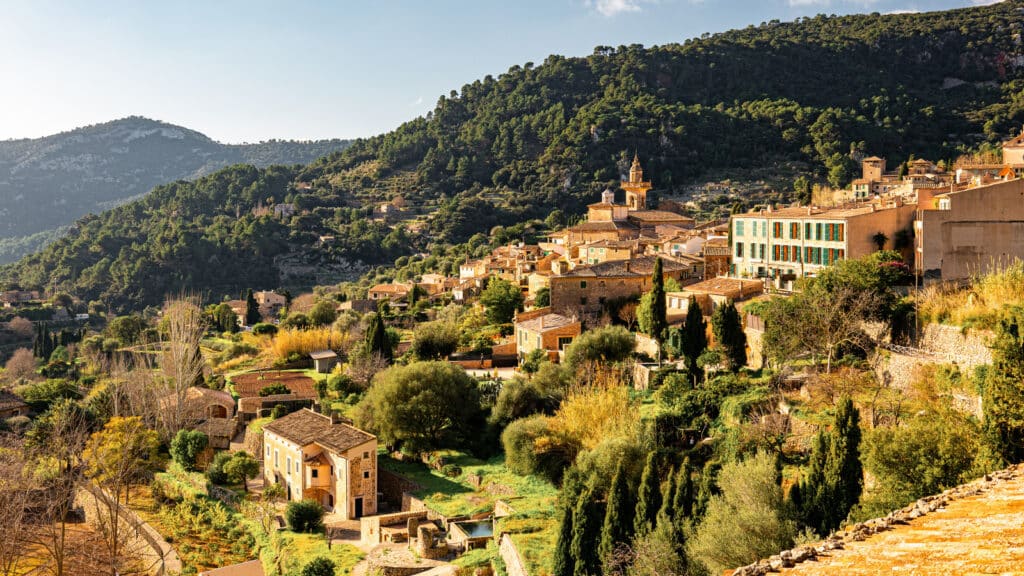
Moving along the Tramuntana coast, the market takes on a more introspective tone. Deià, Valldemossa, and Sóller are magnets for buyers seeking permanence over profit. These towns attract a highly specific cohort: affluent Northern Europeans — especially Germans, Swiss, and Scandinavians — as well as British creatives, French intellectuals, and American cultural investors. Transactions here are discreet, often private, and typically center around centuries-old fincas, stone estates, or bohemian hideaways. In this segment, scarcity is real, and legacy — not liquidity — is the asset of choice.
The central plain of Mallorca, notably Alaró, Santa Maria, and Binissalem, has become the domain of land-focused buyers — German-speaking families, sustainability-minded relocators, and hybrid residents who want proximity to Palma without sacrificing space or serenity. The properties that perform best in this region are self-sustaining fincas, vineyard estates, and homes with renewable energy integration. Here, “green” is both a lifestyle and an investment strategy.
The island’s southeast — including Santanyí, Ses Salines, and Campos — is quietly redefining contemporary Mediterranean architecture. This region is a magnet for French, Belgian, and German buyers with a design sensibility. Properties emphasize minimalism, fluid layouts, and environmental harmony. BREEAM (Building Research Establishment Environmental Assessment Methodology) or Passivhaus-certified homes are standard bearers, and buyers are willing to pay a premium for aesthetic coherence and low ecological impact.
Meanwhile, the northeast and east coasts — particularly Artà, Colònia de Sant Pere, and Canyamel — represent Mallorca’s underappreciated luxury frontier. Dutch, Austrian, and German investors are entering early, capitalizing on infrastructure upgrades and anticipated planning reforms. The opportunity here is clear: capital gain over a 5–10 year horizon, with first-mover advantage baked in.
The north — spanning Pollença, Alcúdia, and Playa de Muro — remains Mallorca’s reliable, family-friendly stronghold. British and French households dominate this market segment, drawn by accessibility, amenities, and short-term rental income potential. These buyers value functionality and beach access over architectural purity, but their demand remains steady — especially for mid-range villas with pools and proximity to outdoor pursuits like cycling, hiking, and sailing.
Central Island – Algaida, Sineu, Porreres – Nestled within a diverse and picturesque landscape, the central region of the island offers breathtaking views of the Tramuntana mountains as a stunning natural backdrop. Properties in this area seamlessly blend authentic Mallorcan charm with generous interior volumes and spacious plots. Ideally located less than 25 minutes from both Palma and the airport, they also benefit from proximity to lively towns that maintain year-round activity and community life.
What is reshaping demand
Several macro trends are reshaping demand across all segments. Chief among them is the rising influence of American capital. Driven by political uncertainty abroad, and a renewed focus on lifestyle durability, U.S. buyers are now entering price brackets once dominated solely by Europeans.
Simultaneously, eco-consciousness has become a defining filter. Buyers are willing to pay a 10–20% premium for homes that are energy-independent, solar-equipped, and water-autonomous. These aren’t niche preferences anymore — they’re becoming mainstream prerequisites, particularly for primary residences and long-stay retreats.
Remote work has also transitioned from pandemic adaptation to long-term strategy. Properties with integrated workspaces, high-speed connectivity, guest quarters, or creative studios are consistently outperforming their conventional counterparts. Time-on-market is shrinking, and bidding velocity is increasing for homes that enable a seamless blend of productivity and personal refuge.
Lifestyle, legacy and liquidity
Perhaps most importantly, the market is bifurcating. On one end are legacy buyers, who acquire for generational continuity and emotional anchor. On the other, a new generation of liquidity-conscious investors is optimizing for optionality, rental yield, and resale flexibility. The smartest assets are those that deliver both: lifestyle security today and financial resilience tomorrow.
Mallorca is no longer a peripheral luxury market. It has become a Mediterranean core asset — strategically chosen, deliberately held, and emotionally significant. The island is not just being bought; it is being claimed.
To understand “who buys what and where” is to understand the new architecture of wealth, mobility, and lifestyle migration. The successful operator in this market will be part analyst, part advisor, and part interpreter of life stages and aspirations. It’s no longer about selling square meters. It’s about mapping meaning.
Mallorca in 2025 isn’t just a destination. It’s a decision — and increasingly, a defining one.